
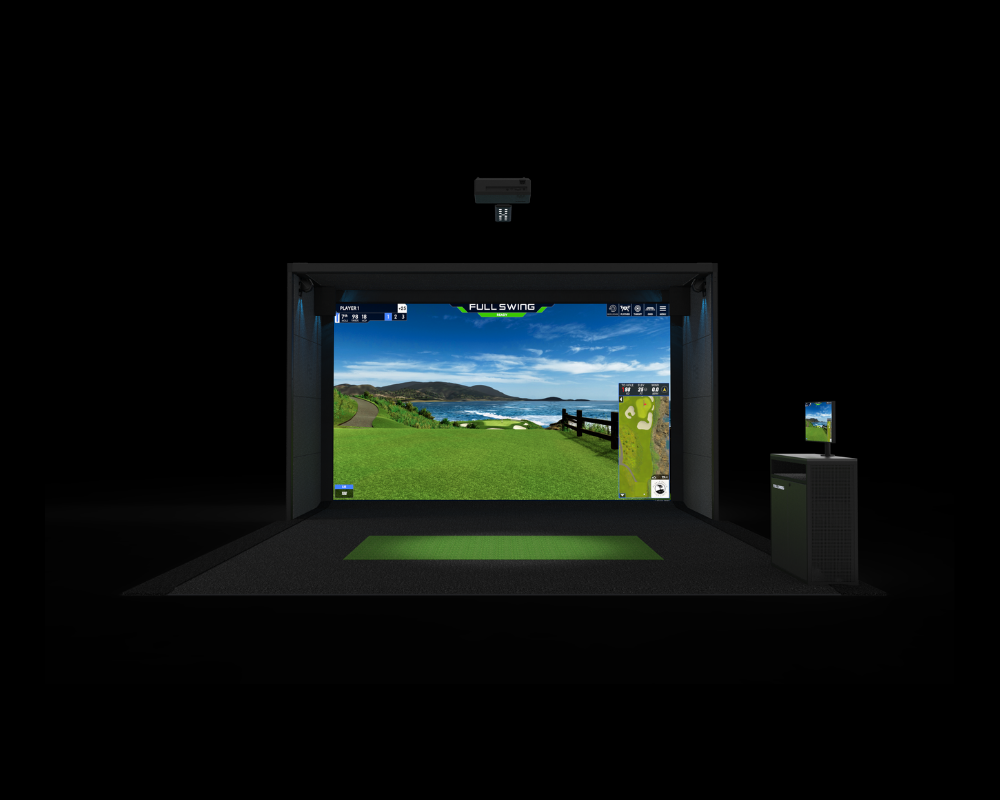
There’s a quiet truth in the world of high-end home golf setups that very few people talk about:
Most of them underdeliver.
Not just because of the technology.
Not because of the brand.
But because the space was never right to begin with.
And once it’s installed… it’s too late.
The Hidden Problem No One Mentions
If you’ve spent any time researching simulators, you’ve likely seen the same narrative:
- “You can make it work in almost any room”
- “Modern systems are flexible”
- “We’ll design around your space”
All technically true.
But here’s what’s often left unsaid:
Just because you can fit a simulator into a space doesn’t mean you should.
Because what you’re really buying isn’t a piece of technology.
You’re buying an experience. A space you’ll want to use consistently. And if that experience feels compromised - even slightly - you’ll use it less than you expect.
What This Looks Like in Reality
We’ve seen this play out countless times in premium homes:
A beautifully designed room.
A top-tier simulator.
A significant investment.
Yet:
- The ceiling subtly restricts a full driver swing
- The room forces an off-centre hitting position
- The ball flight feels “off” compared to real play
- Guests try it once… and don’t come back to it
Nothing is technically “wrong”.
But it doesn’t feel right.
And that’s the difference between something you occasionally use and something that becomes part of your lifestyle.
The 3 Dimensions That Decide Everything
If you strip away all the marketing, all the tech, and all the aesthetics, your entire experience comes down to three variables:
1. Ceiling Height - The Non-Negotiable
This is the one constraint you cannot work around.
If you feel even a hint of restriction in your swing, two things happen immediately:
- You subconsciously adjust your mechanics
- The experience loses authenticity
Minimum viable: 8ft (2.44m)
Comfortable: 10ft (3m)
Ideal (especially for taller players): 10–11ft+
When you are looking to install a top end piece of technology in your home, and especially if you are looking for a simulator for a commercial venue, 3m+ is definitely the way to go.
Because the moment you hesitate at the top of your swing…
you’ve already compromised the entire point of having it.
2. Width - Freedom & Social Use
Width is less talked about - but just as important.
A narrow room creates subtle friction:
- You stand off-centre
- Alignment feels unnatural
- Left- and right-handed play becomes awkward
Minimum: 10.8ft (3.3m)
Recommended: 12 - 17ft (3.6 – 5.2m)
If you ever plan to use the space socially - which, realistically, you will - this becomes even more critical.
Because a simulator isn’t just for practice.
It’s a social asset.
And cramped spaces don’t lend themselves to that.
3. Depth - Where Most Setups Fail
This is the dimension most people underestimate.
Depth controls:
- Ball tracking accuracy
- Visual immersion
- Safety and comfort
Minimum: 12.3ft (3.75m)
Recommended: 16.4 – 20.5ft+ (5 – 6.25m)
In high-performance setups, the hitting position typically sits around 10.6ft (3.25m) from the screen.
That space is what allows:
- Accurate ball data
- A more realistic sense of flight
- A cleaner visual experience with decreased likelihood of head shadow issues from the projector
Reduce that distance, and everything starts to feel slightly artificial.
Not dramatically, but enough to notice.
The “Ideal” Setup (If You Want It Done Properly)
If you’re aiming for something that genuinely replicates a premium environment -
something closer to a private members’ club than a home add-on - the minimum space requirements are:
- Height: 8.4ft+ (2.55m)
- Width: 10.8ft+ (3.3m)
- Depth: 16.4ft+ (5m)
With a clearance height over the hitting area of 3m. But if you are taller, or looking for the most comfortable and premium experience, looking at a bigger space will yield better results.
This is the point where:
- You stop thinking about the space
- You swing naturally
- The experience feels seamless
Anything below this can still work.
But you’re now entering the territory of trade-offs.
Can Smaller Spaces Work?
Yes. But this is where honesty matters.
A smaller room can absolutely accommodate a simulator.
However, the compromises are real:
- Reduced screen size
- Limited use of longer clubs
- Less immersive visuals
- More technical constraints in setup
For some, that’s acceptable.
For others - particularly if this is positioned as a lifestyle feature - it can feel underwhelming over time.
The key question isn’t:
“Can I fit one in?”
It’s:
“Will I actually enjoy using it long-term?”
The Strategic Mistake Most Buyers Make
Most people approach this backwards.
They start with:
“I have this room - what can I fit into it?”
The better approach is:
“What experience do I want - and what space does that require?”
Because once you define the experience first,
the decisions become much clearer.
A Smarter Way to Approach It
Before committing to anything, take a step back and do three simple things:
1. Test the Space Physically
Take your driver and swing freely in the room.
Not carefully - naturally.
2. Measure Precisely
Not estimates. Not assumptions.
Exact dimensions.
3. Think Beyond Installation
Consider:
- How it will be used
- Who will use it
- How often
- In what context (solo, social, family)
Because the real value isn’t in having a simulator.
It’s in how often it becomes part of your life.
What This Really Comes Down To
At this level, this isn’t just a purchase.
It’s a reflection of:
- How you spend your time
- How you entertain
- How you invest in your environment
Done right, it becomes:
- A private escape
- A performance tool
- A social centrepiece
Done poorly…
it becomes something you show people once, then forget about.
The Bottom Line
You don’t need unlimited space.
But you do need the right space.
Because in the end, the difference between:
- “That’s impressive”
and - “I use this all the time”
…comes down to a few feet in each direction.
The Tech Stack Powering TGL: How FULL SWING Helps Build Golf’s Most High-Tech League
The Masters Playbook: Practice Habits You Should Copy