
The 2025 Masters Final Round drew an audience of 12.7 million, golf’s largest audience in seven years. As the world held its breath for Rory McIlory, watching in anticipation as he clinched the final win needed for his Career Grand Slam, fans are left wondering – how do the Pros deliver incredible shots and iconic moments under such intense pressure?
There is no secret formula for achieving greatness. The path is rather obvious. But it is far from simple. It is hard work, and often not what most amateur golfers want to hear.
Players don’t just turn up ready to play Augusta on Thursday. They dedicate their time, their minds and their bodies to their game for months to ensure they get the best possibly result. They practice relentlessly.
As an amateur golfer, this is what should serve as inspiration for your game. You might not be a pro, but you can train like one.
The Beauty of Intentional Practice
At Augusta, nothing is accidental. That philosophy extends far beyond tournament play - it’s embedded in how players prepare.
Spend time watching the practice areas during Masters week and you’ll notice something striking. Players aren’t just warming up - they’re rehearsing. Hours are spent hitting specific shots with specific purposes, often simulating the exact conditions they’ll face on the course. In windy conditions, for example, pros will cycle through every club in the bag, working on trajectory control, shaping shots to fight the elements rather than simply reacting to them.
Even on the putting green, the attention to detail is relentless. Players circle holes, putting from every conceivable angle to understand how wind and slope interact. It’s not casual - it’s calculated.
For amateurs, this raises an important question: how often is your practice this intentional?
Slow Down: The Fundamentals Still Matter
One of the most revealing differences between amateurs and professionals is patience, especially with the basics.
At the Masters, even the world’s best players dedicate significant time to setup and alignment. Scottie Scheffler, for instance, has been observed spending nearly 30 minutes working purely on pre-swing fundamentals, often hitting very few balls. That’s a stark contrast to most amateur routines, where more tedious drills are often ditched within minutes in favour of much more satisfying, but often less effective, practice.
There’s a lesson here that’s easy to overlook - improvement doesn’t always look like hitting more balls. Sometimes it looks like slowing down, stepping back, and refining the foundation.
Try starting your next session without a ball at all. Focus on grip, stance, posture, and alignment. It might feel uncomfortable, or uninteresting, but that discomfort and focus is often where real progress begins.
Practice With Purpose, Not Just Repetition
Another hallmark of Master’s preparation is clarity of intent. When Rory McIlroy works through his bag, every shot has a defined purpose: target, trajectory, and distance. He might hit multiple shots with the same club, each with a different flight, all landing in roughly the same spot.
Too often, amateurs fall into the trap of “just hitting balls,” hoping improvement will follow through repetition alone. But the pros demonstrate that quality matters far more than quantity.
A simple shift can make a big difference: before you practice, define three specific goals. Maybe it’s controlling distance with your wedges, shaping a fade with your mid-irons, or improving contact consistency. When every swing has a purpose, practice becomes far more effective, and far more engaging.
Embracing Variety and Creativity
Watch the short game area at Augusta, and you’ll see creativity on full display. Players like Tiger Woods don’t just practice one shot - they practice multiple solutions to the same problem. From a single spot, they might hit a high flop, a bump-and-run, and something in between.
This approach builds adaptability, which is crucial on a course like Augusta, where conditions - especially the wind - can be unpredictable. As caddie Ted Scott put it, the wind at Augusta “hides from you… the moment the ball peaks above the Georgia pines, it gets slapped in a strange direction”.
That unpredictability is exactly why creativity matters. You can’t rely on one stock shot - you need options.
By practicing your options, you are more prepared for any eventuality. But you also strengthen another essential skill - decision-making. Not only do you need to have options for how to play a shot, but you need to feel confident in your ability to choose the best option when the pressure is at it’s highest.
For amateur golfers, this is a powerful takeaway. Don’t just practice the shot you’re comfortable with. Practice alternatives. Learn to see multiple ways to play the same situation. That’s how confidence grows. Not from perfection, but from versatility.
Balancing Technique With Feel
There’s a common misconception that elite players are purely mechanical. In reality, the best in the world strike a balance between technical precision and instinctive feel.
This balance is key. Too much technical focus can make the swing rigid. Too much reliance on feel can make it inconsistent. The magic happens in between.
A practical approach? Divide your practice time. Spend part of it working on mechanics, then shift into a more creative mode - visualizing shots, experimenting with ball flights, and trusting your instincts.
The Role of Modern Technology
While tradition runs deep at the Masters, modern technology has quietly become part of the preparation process - even for legends like Tiger Woods.
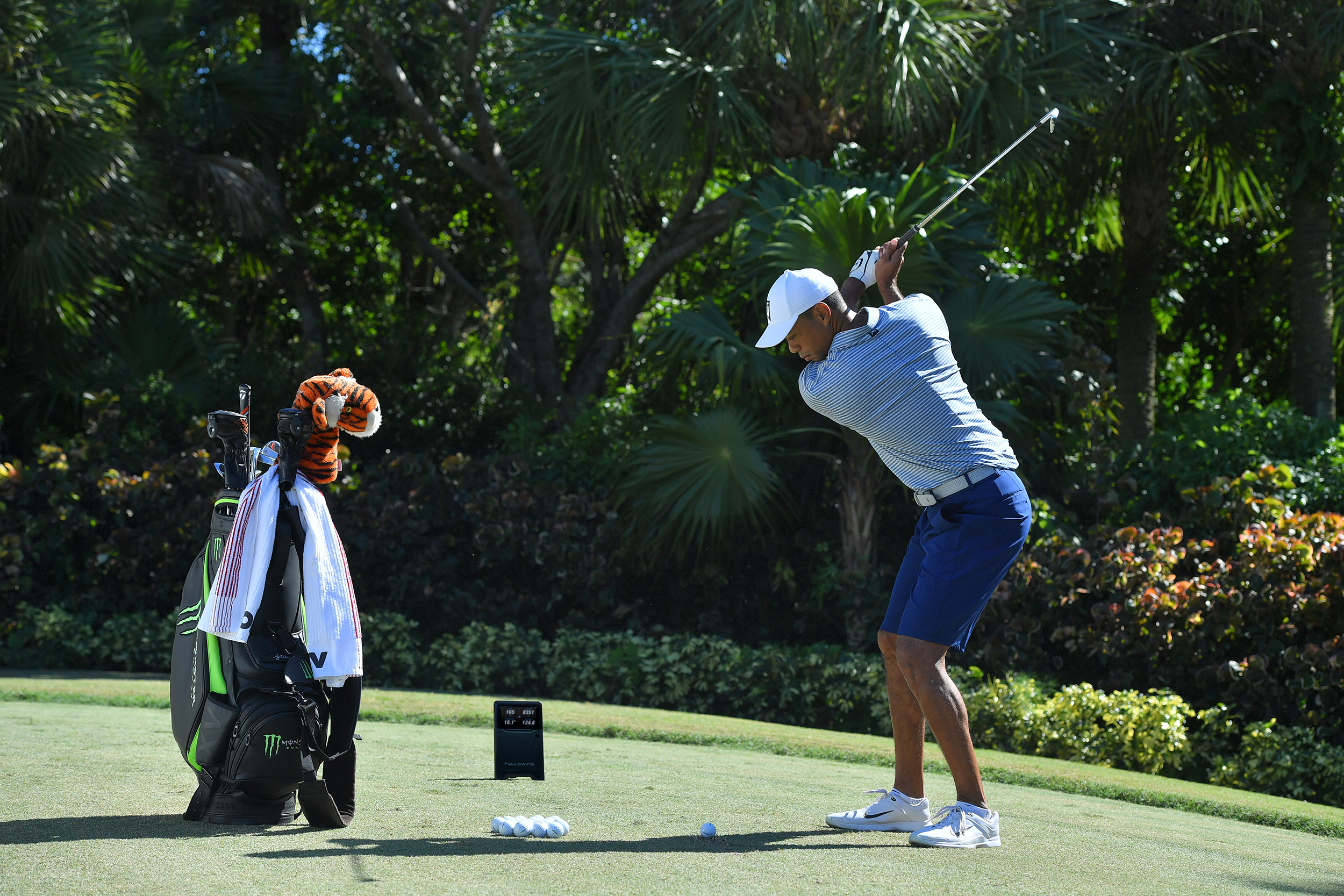
During his Masters practice sessions following his return to golf in 2022, Woods relied on the FULL SWING KIT launch monitor, a device he helped design. It tracks critical data points like ball speed, launch angle, spin rate, and carry distance, providing precise feedback on every swing.
But what’s most interesting isn’t just the technology - it’s how it’s used.
A launch monitor isn’t about overcomplicating the swing. It’s about validating feel with fact. It helps golfers understand whether the changes they’re trying to make are actually producing the desired results. It bridges the gap between what you think you’re doing and what’s really happening.
For amateurs, this is where tools like launch monitors can quietly transform practice. They bring structure, feedback, and accountability - three elements that define how the pros train.
Instead of guessing distances or relying purely on feel, you gain clarity. You learn your true yardages. You understand how subtle swing changes affect ball flight. And perhaps most importantly, you can practice with the same level of intention that defines preparation at Augusta.
Finishing Strong
One final detail separates the best from the rest: how they end their practice sessions.
It’s a small psychological edge—but a powerful one.
For amateurs, adopting this habit can change how you carry confidence from the range to the course. Always end on a good shot. Leave the practice area feeling capable, not frustrated.
Bringing Augusta Into Your Game
Just because you aren’t competing in the Masters, doesn’t mean you can’t practice like a champion.
Whether you are Rory McIlroy on the 15th in Round 4, or a golfer teeing off with your mates on the 15th of your local golf club, the way you hone your game is the same.
What you need is intention.
The players at the Masters show us that improvement isn’t about hitting more balls - it’s about hitting better ones.
It’s about structure, purpose, creativity, and feedback. And increasingly, it’s about using the right tools. That could be a simple alignment stick or advanced technology like launch monitor – whatever it takes to make practice more meaningful.
It’s about consistency. Its knowing that the best in the game don’t take a day off because its windy, or raining. They either practice in those conditions, or they use tools, like indoor set-ups and golf simulators, that allow them to be consistent all year round, even when they can’t get out on course.
Because in the end, the lesson from Augusta is simple: excellence isn’t accidental.
It’s practiced.
Thinking About an Indoor Golf Simulator? Read This Before You Commit £40,000+ to the Wrong Space.